Aaron Brothers Art Framing California 111 Palm Desert Ca Closing?
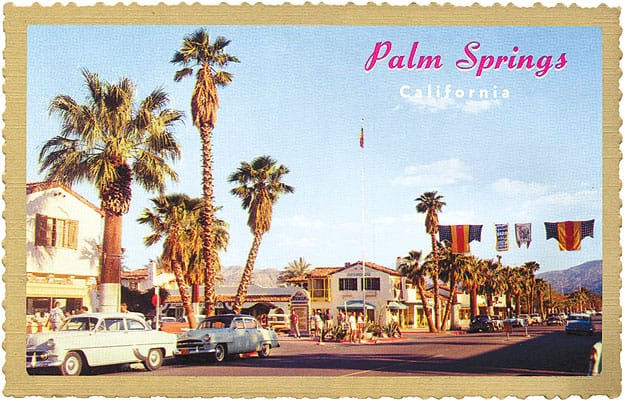
70-v years ago on Dec. 12, Greta Garbo supposedly snuck into Palm Springs' Plaza Theatre — not to avert paying for a picture show ticket, simply rather to avoid walking downwards the cherry rug for the world premiere of Camille. Her co-star in the film, Robert Taylor, didn't mind the limelight; in fact, he came with Barbara Stanwyck on his arm (they married a few years afterwards).
Home to The Fabulous Palm Springs Follies since 1991, Plaza Theatre is the last space in the La Plaza development with its 1936 name. Desmond's clothing store, however, remained the just original business concern until endmost in 2005.
Tyler'southward, a popular lunch spot for burgers, was originally a gas station (later on becoming a bus depot, so a date shop, then an A&Due west restaurant). Kalura Trattoria was a drugstore before a long stint as Louise's Pantry. Imageville was La Plaza's marketplace — supporting the 21 bungalows and 8 penthouses for rent by the day, week, or month.
A 150-machine parking garage on Arenas Road (expect for the "bullets" just east of Indian Canyon Drive for the entrance/exit location) catered to wealthy guests, with chauffeurs' quarters in a higher place the garage.
La plaza began every bit the vision of Julia Carnell, a Dayton, Ohio, businesswoman whose blood brother-in-police founded National Cash Register Corp. She reportedly paid pioneer Cornelia White $1 1000000 to purchase 3.5 acres of what is now role of downtown. Then she brought NCR's architect, Harry Williams, to the desert to pattern and build the Spanish-style La Plaza. His sons, E. Stewart Williams (one of the desert's iconic midcentury mod architects) and Roger Williams, followed. The three opened an role — Williams, Williams & Williams — at La Plaza, where, the story goes, Frank Sinatra walked in eating an ice cream cone in May 1947 and said he wanted a firm built past Christmas.
According to an article written by Harry Williams for the December 1936 effect of Palm Springs Parade, Carnell directed him and his crew from Ohio to relieve the copse and shrubs that were on the property. "We not simply saved them but we spotted them every bit an integral part of the architectural renderings of our building," he wrote. "We knew exactly which trees were to be used before each building and to the inch how loftier they would be and how they would impact the complete scene."
Williams further explained the aesthetics of the buildings themselves: "What I wanted in the Plaza was openness and lack of pretence. The lines must be horizontal and inviting. The hurry and scurry of modernistic metropolitan life is an anachronism in the timelessness of the desert, where mountains a million years old pout upon the futility of haste, and this must somehow be expressed in the contours of our projection."
Palm Springs Desert Museum (now Palm Springs Art Museum) opened in La Plaza in January 1938. In Desert Dream Fulfilled: The History of the Palm Springs Desert Museum, Patricia Mastic writes, "This was a selection location, even if the rent — $120 per calendar month — was high. Though information technology was at the border of the business organisation district when built in 1936, the Plaza had apace become a gathering place. Because Palm Springs was a town of few attractions, locals enjoyed the genial atmosphere of the arcade." La Plaza and the museum's current edifice a block west of Palm Coulee Drive share a family connection: the latter was designed by E. Stewart Williams in the early 1970s.
Past 1939, businesses included Plaza Pharmacy, Potter's Hardware, and Kubic'southward Garden of Edom ("growers of the globe's sweetest grapefruit"). Realtor Robert Ransom managed the development. In one ad, he describes La Plaza'due south eclectic attractions: "Inside the limits of this group of smart La Plaza Shops you can buy a piece of driftwood or the newest in sportswear for men and women. Have your automobile fixed or hire a Hertz-You-Bulldoze. Buy a Cadillac, a diamond or a lamb chop. Have the family laundry and cleaning done and with no effort at all select a gift for any member of your family."
It was a Riverside-based automobile dealer that brought Caddies to La Plaza to supplement its primary business before opening Plaza Motors in 1938.
But la plaza fell on hard times. Harry Pitts was at Louise's Pantry in 1951 when he heard that the plaza was going to be auctioned the following day. "My gramps got together 10 people that nighttime, and they all agreed to make a bid on it," says Larry Pitts, president of Plaza Investment Visitor Inc., the visitor formed by those investors and now managing the property. "Descendants of four of the x remain investors."
When Plaza Motors moved north on Indian Canyon Drive in 1954, La Plaza owners operated a Plaza DeSoto-Plymouth dealership in the former garage. Two years subsequently, the garage metamorphosed into a furniture shop. From 1972 to 1982, Aaron Brothers framing and art supplies took over the street level and invited artists to fix up studios/kiosks to sell their piece of work in the basement. When the store moved out in the early 1980s, Plaza Investment divided the street-level space into individual stores. The upper level, which had been used for a men'southward lodge since the '50s, was vacated, though a women's order in the upper level of another La Plaza building remained in operation into the '90s, Pitts says.
Milt Jones, publisher of Palm Springs Life, and Bud Taylor ran an advertising agency, the Taylor Jones Agency, in La Plaza from 1958 to 1962, converting a portion of Taylor's upper-level living quarters into their office. "We called it Penthouse 27," Jones recalls (27 being the number of Taylor's apartment). "Below us, where Encounter's Candies is now, was Phil Siegel'south camera store. He moved out and Ted Land Shoes moved in." Jones also recalls a shoeshine shop (since torn down) west of what is now Tyler'south.
When opened, the theater featured seats upholstered in antique white leather and twinkling lights in the ceiling to reproduce constellations in the night sky. It was used for national radio shows, including Amos 'northward' Andy, Jack Benny, and Bob Hope, also as for an annual charity revue with famous performers such as Frank Sinatra and Donald O'Connor. It as well was used to help pay off the mortgage on La Plaza through its sale to its original operator, Earle Strebe.
In the 1980s, Metropolitan Theaters split the theater into a duplex cinema. A year later on Metropolitan moved out in 1987, the Palm Springs Metropolis Council, led past Mayor Sonny Bono, entered into a lease-purchase contract with the idea of using the theater as a Palm Springs International Pic Festival venue (the city purchased the property in 1999). But a 10-days-a-twelvemonth use fell short of the theater's potential.
So, in 1990, Quango Member Tuck Broick learned of the show business background of i of the volunteers to help the urban center supervise bound interruption crowds. "I said, 'We need to have something done with the theater. Come over and I volition testify it to you,'" Broick recalls. When he saw the landmark, the volunteer — Riff Markowitz — recognized its latent beauty and in short order adult a concept for it: The Fabulous Palm Springs Follies.
Mayhap a petty karma was at work: The theater's Dec. 12 opening date coincides with Markowitz's altogether.
Palm Springs Historical Society offers walking tours of downtown, including La Plaza, on Wednesdays, Fridays, and Saturdays at 9:45 a.m.
danielspladid1976.blogspot.com
Source: https://www.palmspringslife.com/it-takes-a-village-2/
0 Response to "Aaron Brothers Art Framing California 111 Palm Desert Ca Closing?"
Postar um comentário