Why Has No One Gone to the Moon Again
In July 1969 humans landed on the Moon for the first time, as role of the Apollo 11 mission. But why haven't we been back since the Apollo 17 mission in 1972?
Why haven't we been back to the Moon?
The Apollo 11 Moon landing in July 1969 was a huge feat of human try, technology and science. It was a moment that the world had been waiting for.
Apollo 11 was followed past 6 further trips to the Moon, five of which landed successfully. 12 men walked on the lunar surface in total.Only in 1970 future Apollo missions were cancelled. Apollo 17 became the final manned mission to the Moon, for an indefinite amount of time.
The main reason for this was money. The toll of getting to the Moon was, ironically, astronomical.
When was the last time we went to infinite?
Although we haven't put a human on the lunar surface since the 1970s, there are now regular crewed missions to space.
Skylab - 1973-1974
Skylab was the start NASA managed and operated space station. It operated between May 1973 and Feb 1974. It had a workshop, an observatory and carried out hundreds of experiments.
Development and further use of Skylab was delayed due to bug developing the Space shuttle. Somewhen the orbital decay of Skylab could not be stopped. Orbital decay is the gradual subtract of distance between two objects in orbit of each other.
Infinite Shuttle - 1981-2011
The first reusable spacecraft, NASA's Infinite Shuttle enabled satellites to be launched and returned to Earth. The crewed spacecraft allowed NASA to travel to recover damaged satellites, fix them and send them back into space. The Space Shuttle was also instrumental in the evolution of the ISS.
Mir space station - 1986-2001
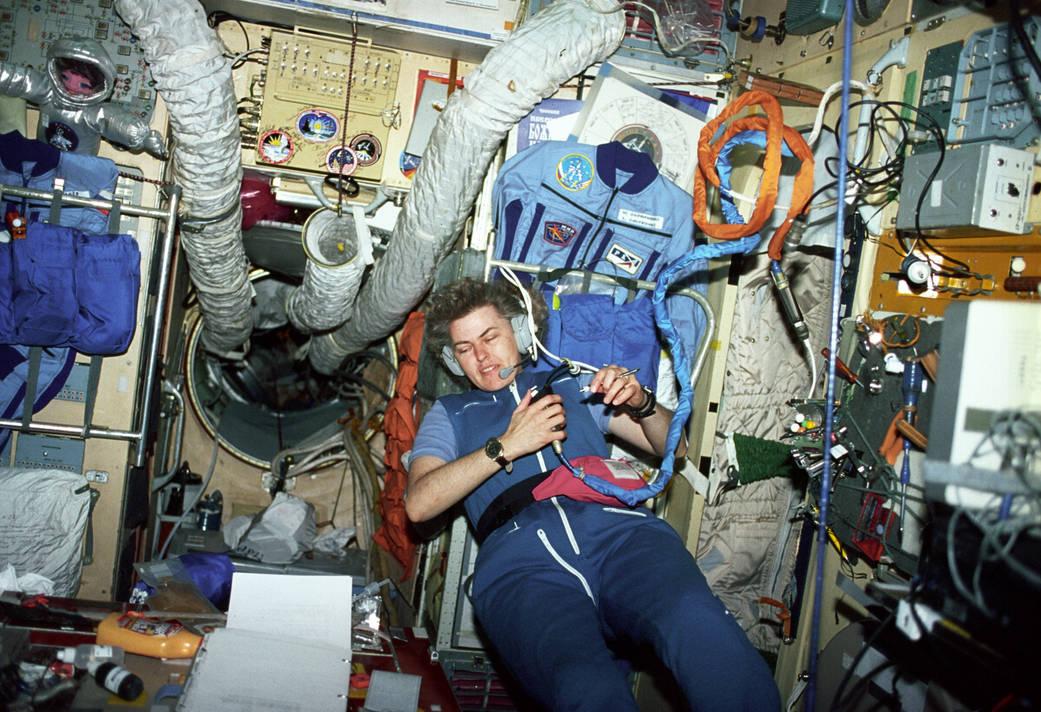
Mir was a Russian space station that was in operation from 1986 until 2001, and was the first continuously inhabited research station in orbit. Many experiments were carried out on the space station, and its success would go the pattern for the current International Space Station.
International Space Station - 1988-present
The International Infinite Station, or ISS, is a continuously inhabited bogus satellite in low World orbit. A joint project betwixt the United states, Russia, Japan, Europe and Canada, astronauts aboard the ISS comport out various experiments, and live on the station for nigh six months at a fourth dimension.
When was the last time humans were on the Moon?
The final manned mission to the Moon was Apollo 17, taking place between 7 and 19 December 1972. It was a 12-day mission and broke many records, the longest infinite walk, the longest lunar landing and the largest lunar samples brought back to Earth.
Harrison H. Schmitt was the lunar module airplane pilot, as well equally beingness a geologist. He was joined by Ronald E. Evans as command module pilot and Eugene Cernan every bit Mission Commander.
Space Race timeline
Apollo 17 was the just Apollo mission to not carry any astronauts who had previously been test pilots. Later on the cancellation of Apollo 18, the Apollo mission Schmitt had originally intended to proceed, the scientific community lobbied that he be put onto Apollo 17.
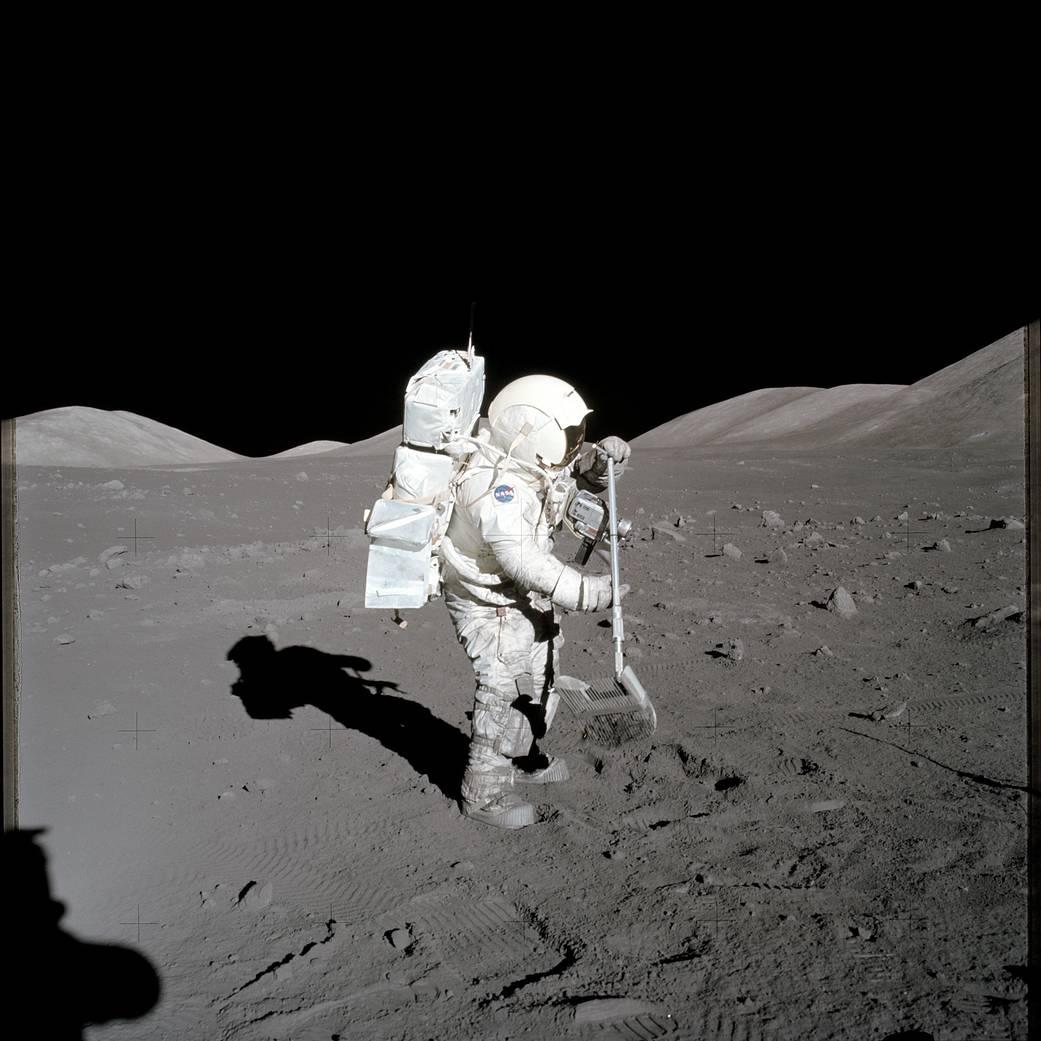
Cernan was the terminal to get out the lunar surface, and therefore is the most contempo person to stand on the Moon. As he ascended to the lunar module he said:
"...I'm on the surface; and, as I take homo's concluding footstep from the surface, dorsum home for some time to come - just we believe not too long into the hereafter - I'd like to just [say] what I believe history will record. That America's claiming of today has forged man'south destiny of tomorrow. And, as nosotros leave the Moon at Taurus-Littrow, we leave as we came and, God willing, equally nosotros shall return, with peace and hope for all mankind. Godspeed the crew of Apollo 17."
Whilst manned missions to the moon have stopped, inquiry into the moon and journeys to space still take place. There are besides future plans for journeys to the Moon. NASA'southward Artemis Program aims to return to the Moon by 2024, and gear up up a sustained human presence that would let u.s. to regularly visit our celestial neighbor.
Find out more virtually the hereafter of space travel
Why NASA stopped going to the moon
The race to land humans on the Moon was kickstarted by President John F. Kennedy's 1962 speech at Rice Stadium in Houston, Texas, now known as the 'We Choose to get to the Moon' speech. In the speech, Kennedy committed to getting a human to walk on the Moon past the end of the decade:
"And this will exist done in the decade of the 60s. It may be washed while some of yous are still here at schoolhouse at this college and university. It will be done during the term of office of some of the people who sit hither on this platform. But it will be done. And it will be washed earlier the terminate of this decade."
When the Moon landing took place in 1969, Kennedy'south goal had been achieved, and his deadline met.
However, with the goal achieved NASA faced large funding cuts, making the future of the Apollo missions untenable. There had originally been 20 Apollo missions planned, simply technological and research based missions were not seen equally important as the accomplishment of the Moon landing itself, and the final three missions were cancelled.
Whilst the US government was willing to put a lot of money in to the Apollo missions when information technology was helpful to the space race, research and technological development were not viewed as a priority. Apollo 11 was a political statement in the midst of the space race, and once information technology had been made, the necessity for more missions to the Moon was gone.
Recent NASA ambassador Jim Bridenstine highlighted this when he described the space race thus:
"This wasa contest of political ideologies. It was a contest of economical ideologies. It was a contest of technological prowess. And in this dandy contest of great powers the Usa of America was determined to win."
Going to the Moon was hugely expensive. Originally Kennedy's regime had estimated $7 billion dollars. In the cease, the total cost was $20 billion dollars.
There was likewise less national support. The Apollo missions had all taken place against the backdrop of ceremonious unrest in the US, and the large amounts of money being spent on infinite travel became a point of contention for the American public.
As the Cold War thawed, the Strategic Arms Limitations Talks (Common salt) meant that missile product - including those used for space travel - was drastically reduced.
Future plans to go to the Moon are besides driven past money. Whilst the Apollo missions saw astronauts live on the Moon for simply a few days at a time, journeys to the moon in the 21st century would focus more on the creation of lunar bases or satellites. Bridensteine describes how the future of Lunar travel is about a sustained presence on the Moon.
"This time when nosotros go to the Moon we're going to stay. That'south what we're looking to do."
danielspladid1976.blogspot.com
Source: https://www.rmg.co.uk/stories/topics/why-did-we-stop-going-moon
0 Response to "Why Has No One Gone to the Moon Again"
Postar um comentário