Before I Was Will Truman Again I Was a Traveler
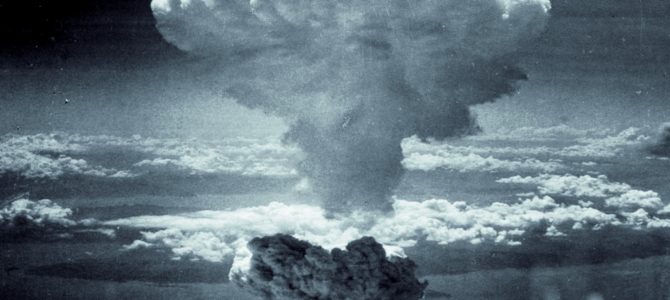
On August 6, 1945, thirty-twelvemonth-old U.Due south. Air Strength pilot Col. Paul W. Tibbets Jr. took to the sky in the Enola Gay, his Boeing B-29 Superfortress heavy bomber. His destination, the Japanese metropolis of Hiroshima, was not an peculiarly notable target. His payload, still, a unmarried flop nicknamed "Piddling Male child," would change the class of history.
Truthful watershed moments in history are rare — the agricultural revolution is i such example, as was the Boxing of Salamis, the advent of Jesus Christ, and the fall of Western Rome. Yet in the last ane,500 years, no two singled-out epochs of time are every bit articulate as the fourth dimension earlier the atomic bombings of Hiroshima and Nagasaki and all the time since.
'Prompt and Utter Destruction'
Eleven days before Tibbets's fateful flight, on July 26, 1945, U.S. President Harry Southward. Truman's "Potsdam Declaration" gave the Empire of Japan one last gamble to surrender unconditionally after more three years of war in the Pacific. If they persisted in fighting, the Potsdam text promised "the total awarding" of U.South. armed services power, culminating in "the inevitable and complete destruction of the Japanese armed forces and just as inevitably the utter destruction of the Japanese homeland." The endmost of the ultimatum rings all the more forebodingly in hindsight: if the Japanese refused the terms, the alternative was "prompt and utter destruction."
In his 1947 memoir "Speaking Frankly," Truman'south Secretarial assistant of State James F. Byrnes observed the Potsdam warning was "phrased then that the threat of utter destruction if Japan resisted was get-go with the hope of a just, though stern, peace if she surrendered." Withal, on July 28, Japan Prime Minister Kantarō Suzuki proclaimed the offered terms "unworthy of public notice" With that, the dice was bandage. Truman gave the terminal go-ahead to driblet the atomic flop on his manner dwelling from Potsdam.
The uranium bomb carried past the Enola Gay exploded over Hiroshima with the might of 15,000 tons of TNT. On Baronial 9, "Fatty Homo," a plutonium device of even greater explosive power, was dropped on Nagasaki. The desolation wrought by the blasts was unimaginable. Including the effects caused by radiations, estimates for the number of mortalities range from around 110,000 to a high of 210,000.
Utterly shaken by the display, within one solar day, the Japanese agreed to a conditional surrender, a opinion that was rejected, as promised, by the United States. By Baronial 14, notwithstanding, the Japanese agreed to accept the Potsdam Proclamation without whatsoever weather condition. Formal give up took place on September 2, onboard the USS Missouri.

From nearly the moment the war concluded, critics began to set on the atomic act, claiming the bombings were uniquely immoral and unnecessary. Withal today, viewed from 75 years of accumulated data and insight, Truman's determination to drib the atomic flop can be viewed with improve context.
Ultimately, the conclusion played an indispensable function in shocking and unmooring the resolve of Japan's militaristic authorities into unconditional surrender and hastening the end of the Second World War. Furthermore, intended or non, the determination deterred short-term Soviet aggression, sparing much of Eastern Europe and parts of Asia from savage Soviet domination.
Most importantly, Truman'due south fateful choice saved millions of American and Japanese lives. Information technology was the correct and justified decision 75 years ago, and it remains so today.
'A Psychological Weapon'
In his testimony to the U.S. Senate on May 11, 1951, Gen. George C. Marshall conveyed the terrible challenge facing the U.S war machine in 1945:
Information technology was axiomatic to the states that the Japanese army was however largely in command and they were preparing to fight to the bitter end simply equally they had done on all of the islands up to and including Okinawa. … Therefore, it was the opinion of the Cheifs of Staff … that nothing less than a terrific shock would produce a surrender. … Our not bad struggle there was to precipitate that general give up so that nosotros would not be involved with various hold-out commands in various parts of the Far East. Therefore, our own decision, that of the Chiefs of Staff, was that we had to either invade Japan or bring this to a decision with stupor activeness … the diminutive bomb.
The central conundrum facing the U.S.-led Allied leadership was how to coerce an utterly indefatigable and stubborn Imperial Japan to surrender without caveats or conditions. Afterward three years of intense fighting, the war had to terminate — the sooner the better. The heavy toll of the conflict weighed increasingly on the United States in fiscal, and more importantly, homo treasure.
Non-atomic options for bringing the war to a speedy conclusion raised more doubts and so they dispelled. The prevalent doubtfulness amongst U.South. Army leadership that the Japanese would chop-chop and suddenly back downwards in the face of conventional attacks or a blockade wasn't just grounded on the last three years of fighting its zealous combatants — information technology found historical parallels within living memory.
"Had non their military histories taught them that the hopelessly beaten Confederate Ground forces had battled?" notes historian Herbert Feis, "Had they not witnessed the refusal of the Germans under the fanatic Hitler to give up long after any chance of winning was gone?" Indeed, since 1942, Japanese devotion to the war had developed a fanatical, quasi-religious overtone, and it was doubted by no one who had encountered the Empire's troops in boxing.
The question of a blockade met understandable apprehension. The specter of Japanese planes killing tens of thousands of American sailors in kamikaze attacks was very real. Since the suicide strikes began, Japanese pilots sunk 34 ships — including 3 aircraft carriers — and damaged another 285, including 16 sunk ships and some other 185 damaged in the Okinawa campaign solitary.
Furthermore, a protracted blockade would accept taken a while to injure the well-continued, well-fed Japanese military establishment. Millions of the Empire's average citizens would accept to suffer a dull and agonizing death from starvation.
Strategic bombing of Japanese cities was another pick, but it had been attempted previously to little diplomatic consequence despite the expiry toll. By Baronial of 1945, nearly all Japanese cities with populations over forty,000 had already been devastated by conventional bombing raids.
Aside from sacrosanct cultural locations similar Kyoto or the vi cities "saved" for possible diminutive bombings, meaningful hereafter targets were in short supply. Marshall afterward lamented the horrific firebombing of Tokyo seemingly "had no effect whatsoever" on Japanese morale or towards hastening the Empire's give up, despite killing every bit many as 200,000 civilians.

For those with shut noesis of the acme-undercover Manhattan Project charged with building the world'due south first atomic bomb, there was little debate or doubt that once the bomb was successfully built, it would exist used. The only question was "when?"
The diminutive bomb was the primal to shaking the legendary resolve of Imperial Japan. Still to have the desired result of hastening the war, the flop would have to be deployed in combat — options involving other means of "using" the device were considered just dropped upon further consideration of the risks involved.
On June xvi, 1945, the U.S. Secretary of War'due south advisory Scientific Panel, whose membership featured Enrico Fermi and J.R. Oppenheimer, concluded in their written report:
We can propose no technical sit-in likely to bring an cease to the war; we encounter no adequate alternative to direct armed services use.
Writing 15 years afterward the bombs were dropped, award-winning historian Samuel Eliot Morrison reported a proposal to demonstrate the power of the bomb by detonating it over a relatively uninhabited role of Nippon was rejected for two main reasons. For ane, there was a credible fear that, after the requisite fair warning, Japan would move centrolineal prisoners of war into the expected blast zone.
More chiefly, no one was certain the bomb would work. If, later a grandiose promise of technological power, the bomb was a dud, the United States would discover itself, as Morrison put information technology, "in a ridiculous position" and Japan would accept merely been emboldened to resist longer and with greater ferocity.
Equally Truman'due south Secretary of State of war Henry Stimson afterwards pointed out, "the diminutive bomb was more than than a weapon of terrible destruction; it was a psychological weapon." Dr. Karl Taylor Compton, one-time president of the Massachusetts Plant of Engineering science and member of Truman'south select Acting Committee, subsequently agreed:
Information technology was not one atomic flop, or ii, which brought surrender; it was experience of what an diminutive bomb will actually do to a customs, plus the dread of many more, that was effective.
Nearly a twelvemonth before the end of Globe State of war Two, in a September 18 spoken language before the American Legion, Marshall remarked, "War is the most terrible tragedy of the human being race and it should not exist prolonged an hour longer than is absolutely necessary." Given how mortiferous the Pacific theater had become, something had to be done to finish the war and bring peace as shortly as possible. The atomic bomb was ideally suited for this chore.
Stalling the Cerise Menace
In his 1914 novel "The World Ready Free," H.G. Wells predicted diminutive-based weaponry nineteen years before Leó Szilárd formulated the concept of neutron chain reaction. The power of the new bombs, Wells foretold, would be the concluding disarming statement for the atrocious nature of state of war — but not before "the atomic bombs burst in their fumbling easily."
A memorandum written by Stimson and shared with Truman on April 25, 1945, turned out to be highly prescient. "If the proper utilize of this weapon could be solved," wrote Stimson, "we would have the opportunity to bring the world into a pattern in which the peace of the earth and our civilization can be saved."
Indeed, the use of the bombs had the crucial issue of demonstrating American military might. The show of force sufficiently prevented the Soviets from completely overrunning the Far East and inverse their probable course of action in both Central and Eastern Europe. Ending the war with Nihon every bit quickly every bit possible would preclude the chance for Soviet-Japanese fighting to become a guise for seizing land throughout Asia with no intention of relinquishing conquered lands in the futurity.

Nobel-prize winner P.M.Due south. Blankett argues "the dropping of the atomic bombs was not so much the final military human action of the 2d Earth State of war, as the first major performance in the cold diplomatic war with Russian federation." Even historian Gal Alperovitz, a staunch opponent of the decision to utilize nuclear weapons on Japan, admits that had the United States non dropped the atomic bombs the Soviet Red Army might not have left Czechoslovakia, Hungary, Iran, or Manchuria.
Furthermore, a convincing case can be made that dropping the atomic bombs on Nihon helped ensure a Third World War never occurs. In a 1965 essay, Richard Rovere, a columnist for The New Yorker, wrote, "if we had spared Hiroshima and Nagasaki, we would have been all the more tempted to employ information technology [the diminutive bomb] on Moscow and Petrograd a couple of years subsequently."
Had the full, catastrophic power of atomic weaponry remained unknown until the outbreak of a global E versus Westward conflict, it would accept been too belatedly to forbid nuclear Armageddon. Instead, in our timeline, the Bully Powers of the world are so well enlightened of the terrible possibilities of such technology that even in times of overwhelming tension, would-be antagonists take thus far recoiled at their use in state of war.
Both Atomic and Strategic Bombing Proved War Is Hell
Equally determined by a articulation Manhattan Projection-U.S. Air Force targeting committee, targets for atomic bombing had to be primarily military machine in nature, nonetheless also contain a large enough urban area, relatively untouched by previous U.S. Air Strength bombings, to permit for the damage required to "shock" Japanese leadership into give up.
Hiroshima was the abode to a big shipyard also as Field Marshal Shunroku Hata'south headquarters for the 2d General Army. Originally added as a "finalist" target by Gen. Curtis LeMay's staff as a "bad weather" culling to Kokura, the city of Nagasaki represented a nearly-perfect target for an atomic assail with a loftier run a risk of cowing Nippon to end resistance. The prized electric and ordnance factories of Mitsubishi artillery produced more than than 96 percent of all weapons production by plants with more than than 50 workers; its active dockyards provided additional high-value targets.
Beginning with the wider availability of bomber shipping in the 1930s and certainly, past the 1940s, bombing military targets within cities was allowed and canonical inside the rules of state of war. Civilians killed in such aerial raids were considered "collateral impairment." In truth, the socio-political reality of 1945 might as well take been in a dissimilar universe compared to the express professional armies that took to open fields in the 18th century in ordered lines and brightly colored uniforms.
By World State of war II, generals and politicians alike were attempting to come to grips with the fact that the line between a combatant and a non-combatant, while yet visible, had faded considerably. Equally the size of armies grew from thousands to the hundreds of thousands and even millions, vast portions of social club became necessarily involved with "feeding" such enterprises.
The destruction or incapacitation of plants involved in the manufacturing of weapons, munitions, or even uniforms meant depriving the enemy of war materials that could later exist used to kill one's troops tomorrow, adjacent week, or next month. If one side disabled the gears of war, factories could not produce the means to enable a nation to keep fighting, wars could exist shortened, and more lives would exist saved in the end.

Strategic bombing was built-in out of this theorizing, and its gruesome harvest was arguably as horrible, or worse, equally the ruination left in the wake of the dropping of the diminutive bombs. While the radioactive, psychological, and single-flare-up effects felt at Hiroshima and Nagasaki may accept been unique in the type of terror induced by atomic weapons, the death and injury caused by them was sadly in line with the carnage acquired past conventional bombing raids in the concluding two and half years of World War 2.
Some 22,700 to 25,000 German language civilians died as a consequence of British-American bombing raids on Dresden between February 13-15, 1945. A little more than than a week later, a British Royal Air Strength bombing raid over the southwestern German language boondocks of Pforzheim killed 17,600 — nearly a tertiary of its population.
Allied bombing raids of the German cities of Kassel (Oct 22–23, 1943) and Darmstadt (September eleven-12, 1944) killed at least 10,000 and eleven,500 civilians, respectively. The articulation British-American bombing of Hamburg, Federal republic of germany during the last week of July in 1943 killed an astounding 42,600.
Professor Donald J. Miller, one of the most trusted authorities on World War Two, believes "at least" 100,000 civilians were killed in the Tokyo firebombing raids from March nine-10. Other more recent estimates believe between 75,000 and 200,000 civilians perished during the resulting conflagration. The minimum of 105,000 Japanese who died from the atomic bombs dropped on Hiroshima and Nagasaki is not a testimony to the unique horrors of the attacks, but to the inescapable and undeniable horror of war itself — especially in the 20th century.
'Operation Downfall'
Of the nearly one,250,000 gainsay and gainsay-related casualties the United states sustained in World State of war Ii, nearly 1 one thousand thousand were incurred betwixt June 1944 to June 1945. The difficulty of the combat on Japanese islands, combined with the ferocity and tenacity of Imperial Japan'south fighting forces, brought the state of war in the Pacific to an entirely dissimilar level of danger. The ratio of enemy to U.S. casualties reached horrifying, intolerable numbers. Biting fighting on Okinawa led to a ratio of two to ane; an fifty-fifty ghastlier ratio of 1.25 to 1 occurred with the combat that ended on Iwo Jima.
The astringent casualties suffered at Okinawa and Iwo Jima demonstrated the steely determination of Japanese troops to resist give up. A common fearfulness pervaded U.S. military leadership and the Oval Part that invading the Home Islands would amount to "a string of Okinawas," merely with exponentially college casualties.
In a July 2, 1945, memo to the president, Stimson noted the terrain of the Home Islands was ideal for terminal-ditch defenses and even "more unfavorable to tank maneuvering than either the Philippines or Deutschland." From the first of Performance Downfall, the planned ground invasion of Nihon, 18 months was assumed to be the minimum amount of time needed to bring the state of war to a shut barring "a sudden collapse."
Spooky proof of the carnage expected to follow an amphibious invasion of Japan exists in the more than than 495,000 Purple Heart medals fabricated in anticipation of Performance Downfall's casualties. While the plan scheduled for Nov one, 1945, was never required, the amassed stock of medals was then vast that soldiers injured in the recent Afghanistan and Iraq wars received Imperial Hearts from the very aforementioned stockpile meant for Japan in 1945. Even that harrowing number of Majestic Hearts, however, still likely underestimated likely casualties from Functioning Downfall.

Independently, Los Angeles Times war correspondent Kyle Palmer and former U.S. President Herbert Hoover both came to the conclusion that the nation should caryatid for a minimum of 500,000 expressionless Americans, with as many as one,000,000 dying, to force the Japanese to surrender by conventional means.
The U.South. Ground forces'southward "Summary of Redeployment Forecast" issued on March 14, 1945, anticipated they would need "approximately" 720,000 replacements needed for all of the expected "dead and evacuated wounded" through December 31, 1946 — although this figure was but for U.Southward. Ground forces and Air Strength servicemen and did non include expected losses incurred by the U.S. Navy and the Marines.
"JCS 924," the Articulation Planning Staff's finalized blueprint for the invasion of the Japanese Dwelling house Islands, warned taking the islands "might cost us half a one thousand thousand American lives and many times that number wounded." By the summer of 1945, the number passed effectually B-29 training bases, the Pentagon, and U.Due south. Start Regular army Headquarters in Weimar, Germany was a "best-case scenario" of 500,000 dead American soldiers.
Dropping the Atomic Bombs Saved Millions of Lives
Make no fault, nonetheless: had the war continued into late August and beyond, no 1 would have suffered more than the Japanese people. About ominous of all was the decision of a study compiled past Pentagon planners in July 1945. In addition to the study's projected 400,000 to 800,000 American expressionless and 1.7 to 4 1000000 casualties was that at least 5 to ten million Japanese citizens and soldiers would be killed.
Earlier they saw the destructive power of American diminutive weaponry, leading figures within Imperial Japan's military machine leadership — including Vice Chief of the Naval General Staff Onishi Tikijiro and Army Chief of Staff Gen. Umeza Yoshijiro — privately considered "sacrificing" xx million Japanese civilians in defense of the Home Islands. Fortunately for millions of Japanese and Americans, the terrible scenario of Operation Downfall never happened.
On August 15, over radio airwaves, citizens of Nippon heard the voice of their hallowed emperor for the commencement time. In a pre-recorded transmission afterwards known as the "Jewel Voice Broadcast," Japanese Emperor Hirohito read out loud the Imperial Rescript on the Termination of the Greater Eastern asia War. Without using the give-and-take "surrender," Hirohito announced the end of Japan's resistance subsequently witnessing America'due south "new and roughshod flop," which, he proclaimed threatened not only the "ultimate collapse and obliteration of the Japanese nation" but also "the destruction of all human culture."
Within the harsh confines of wartime, perfectly noble options be only in the realm of fantasy. War typically offers awful alternatives and tragic trade-offs that, sadly, often crave weighing the most precious thing on world: human lives. The terminal major events of World War II remind us that in global conflicts, obvious decisions are few, bloodless victories are rare, and wars must be waged to secure peace equally quickly as possible.
A near-impossible conclusion faced President Harry Due south. Truman in the summer of 1945. To his credit, and to the salvation of millions, his fateful option was the right ane.

danielspladid1976.blogspot.com
Source: https://thefederalist.com/2020/08/06/75-years-later-its-clear-truman-was-right-to-drop-the-atomic-bomb/
0 Response to "Before I Was Will Truman Again I Was a Traveler"
Postar um comentário